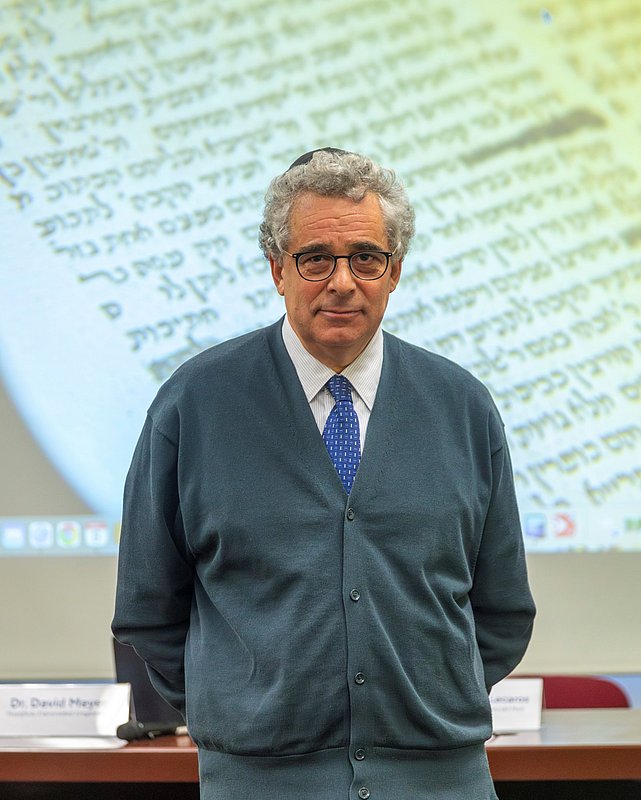
As part of the opening event of the ICCJ international conference in Hanover on Sunday, July 12, Rabbi Dr David Meyer will be awarded the 2026 SEELISBERG PRIZE
The SEELISBERG PRIZE is named in memory of the ground-breaking gathering that occurred in the small Swiss village of Seelisberg from 30 July to 5 August 1947 to address perennial Christian teachings of contempt for Jews and Judaism. It issued the very influential "A Call to the Churches: The Ten Points of Seelisberg" which is widely recognized as inaugurating the transformation in relations between Jews and Christians that has unfolded over the past seventy years
The SEELISBERG PRIZE is awarded annually (since 2022) by the International Council of Christians and Jews (which originated out of the Seelisberg conference) and the Center for Intercultural Theology and Religions at the University of Salzburg.
It honours individuals who have played major roles through their scholarship and teaching in advancing the rapprochement between Jews and Christians.
The 2026 Seelisberg Prize awardee Rabbi Dr David Meyer was born in 1967 in Paris and holds French, Israeli, and Canadian citizenship. He pursued his university education in France, completing an initial degree in Applied Mathematics, followed by a Master’s degree at the École des Hautes Études en Sciences Sociales (EHESS). He subsequently undertook rabbinical training at the Leo Baeck College in London, where he was ordained as a rabbi in 1997. He holds a PhD in Religious Studies from Katholieke Universiteit Leuven (KUL), Belgium.
From 1997 to 2006, he served as a community rabbi in Belgium (Brussels) and the United Kingdom (Brighton). He then reoriented his rabbinic work toward academia, specializing in Rabbinic literature, both classical and contemporary, with a particular emphasis on Jewish-Christian dialogue.
Since 2010, he has been a professor at the Cardinal Bea Centre for Judaic Studies at the Pontifical Gregorian University in Rome, where he teaches Classical Rabbinic Literature and Contemporary Jewish Thought. This position has placed him at the heart of sustained encounters between Judaism and Christianity, enabling him to deepen and refine his sensitivity to Christian thought and faith, both through academic engagement. His work in this context has focused, in particular, on the question of theological translatability between religious traditions, that is, the conditions under which concepts, interpretative practices, and forms of discourse may be rendered intelligible across confessional boundaries without being reduced or neutralized.
Alongside this primary engagement, he has also been involved in Jewish-Muslim dialogue and trialogue. This dimension of his work is reflected in a number of his publications. In this context, he has addressed questions related to religious violence through a comparative engagement with both Christian and Muslim voices, seeking to articulate a framework in which scriptural interpretation and hermeneutics may become a site of critical and dialogical reflection rather than conflict.
His publications span several languages and intellectual contexts, reflecting both the breadth of his scholarly engagement and his sustained commitment to interreligious dialogue. A number of his works were originally written in French, including Les versets douloureux (2008), Dix questions sur la violence monothéiste (2017), and Le judaïsme à l’épreuve de la violence (2025), all of which address the complex relationship between scriptural interpretation and religious violence. Some of these works have subsequently been translated into English, most notably as Painful Verses: Bible, Gospel and Quran Between Conflict and Dialogue (2014). Alongside these, he has also published directly in English, including God, Checkmate! (2024), which offers a methodological reflection on midrashic hermeneutics as a theological medium. His work has further reached broader international audiences through translations into other languages, such as A vida fora da lei (São Paulo), which provides a Talmudic and ethical reflection on the primacy of saving human life. Rabbi Meyer has also contributed to academic volumes and seminars published by the Universidad del Pacifico in Lima (Peru), as well as within Chinese academic contexts.